How long does it take to plan an 11-month walk across Europe?
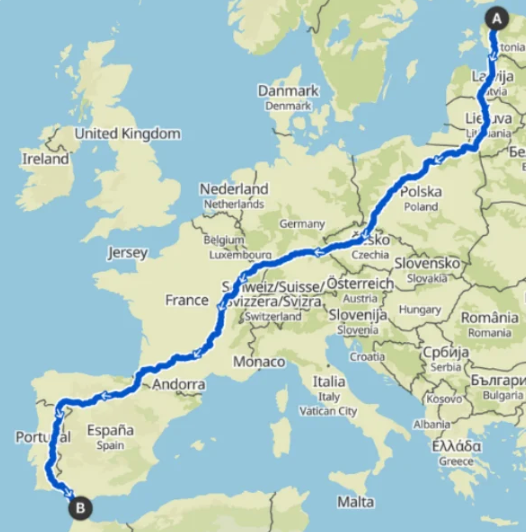
Planning a 6,000-kilometre walk across Europe sounds like an extraordinary logistical undertaking.
I created the detailed route and booked more than 300 accommodations in approximately four weeks, working about four hours a day.
Roughly 112 hours of planning for an 11-month journey.
The tools available today made that possible. But first, I needed to define the constraints that every stage should satisfy.
The operating hypothesis
Could I create a continuous route from Tallinn to Tarifa with:
- approximately 25 kilometres of walking per day;
- no more than 30 kilometres except in extraordinary circumstances;
- accommodation available at the end of every stage;
- a price generally below €100 per night;
- cancellation possible until approximately two weeks before arrival;
- no nights sleeping outdoors;
- and strategic rest days to absorb disruptions?
I exceeded the preferred distance, price or cancellation limits only when there was no suitable accommodation and no reasonable alternative route. Sleeping outdoors was never part of the plan, although I ended sleeping in a barn in Estonia...
Food availability, accepted payment methods and check-in times also required attention. They did not normally determine the route, but they could significantly affect the experience of a stage.
There is little pleasure in arriving hungry somewhere without a restaurant, café, or supermarket, or discovering that a business only accepts cash, or reaching an accommodation several hours before check-in.
Booking.com helped create the route
Most people think of Booking.com as a place to reserve a room after deciding where they want to go.
I used it to determine where I could go.
Starting from one confirmed overnight stop, I searched approximately 25 kilometres ahead in the general direction of Tarifa.
I evaluated the available options against three main factors:
Location: Could I reach it within the daily distance limit?
Price: Was it generally available for €100 or less?
Flexibility: Could I cancel it until approximately two weeks before arrival?
If an option satisfied those conditions, it could become the endpoint of the next stage.
If it didn’t, I looked for different accommodation or an alternative route.
Sometimes the only place available was an expensive holiday home intended for an entire family rather than one walker. In exceptional cases, I accepted the additional cost because there was no other accommodation and no reasonable way around the gap.
The same applied to cancellation. I accepted a fixed reservation only when the route offered no viable alternative.
Across more than 300 advance bookings, I prepaid only about five.
The available accommodation did not merely support the route after I had mapped it.
Its location, price and cancellation conditions helped determine where the route could go.
I checked every stage twice
Finding accommodation established the endpoints. It did not guarantee that the route between them was appropriate.
For every stage, I compared the alternatives proposed by Komoot and Google Maps.
When both suggested reasonably consistent routes and distances, I had greater confidence in the stage.
When they disagreed, I examined the alternatives more closely. A short route on one platform might involve an unsuitable road, while another could add several kilometres through a safer or more walkable area.
Neither application was infallible. Comparing them helped expose routes that deserved further attention before I committed to them.
Rest days protected the whole plan
Advance reservations create a chain: one significant delay can affect every booking that follows.
I therefore included strategic rest days throughout the itinerary.
I generally scheduled one after approximately 250 kilometres or a particularly difficult stretch, always in a larger town where I could do a proper laundry.
They allowed for physical problems, unsuitable routes, travel disruptions or other unexpected events. If something put me behind schedule, a rest day could help me recover without reorganising the remainder of the journey.
If nothing went wrong, I rested.
The itinerary was detailed, but it was not based on the assumption that everything would happen exactly as planned.
I used the same system around France
I later applied essentially the same method to my 3,200-kilometre cycling tour around France.
The daily distances and practical requirements were different, but the planning logic remained the same:
Define the constraints, identify viable overnight stops, compare possible routes, preserve cancellation flexibility and build contingency time into the schedule.
The method was not specific to one walk. It had become a reusable system for designing long, self-supported journeys.
Japan adds another layer
I am now using the same approach to examine a possible route from Cape Sata to Cape Soya.
Booking.com works well in Japan, but it does not show every available option.
In remote areas, small family-run inns may be essential to connecting two stages. Some do not appear on the major international booking platforms.
AI can help identify these missing possibilities, search Japanese-language sources, interpret information and uncover accommodation that a conventional Booking.com search may overlook.
It will not replace verification. An inn identified by AI may be closed, unsuitable or based on outdated information.
But it can reveal options that would otherwise remain invisible, especially where one overlooked family inn could close an apparent gap in the route.
The tools have changed since I planned Europe.
The planning principle has not:
Define the constraints first. Then use every available tool to discover whether a viable route exists within them.
Walk your talk,
Franck
P.S.:
What ambitious project appears overwhelming because you are viewing it as one enormous problem rather than a repeatable series of decisions? Reply and tell me. I read every response.
If someone else is intimidated by the logistics of an ambitious undertaking, forward this Field Note to them. They can join WTFT here.
WTFT is free for everyone. If you would like to support the experiments behind it, you can buy me a coffee.
New possibilities delivered to your mail
Free. Only when I have something worthy to share. Unsubscribe anytime.

Member discussion