I missed B2. Did the experiment fail?

I gave myself four weeks to learn Portuguese from scratch.
The target was B2: the level at which I should be able to communicate independently, understand the main ideas of complex conversations and express myself with reasonable fluency.
It was deliberately ambitious.
I wanted to test what concentrated effort could achieve and whether setting a seemingly unreasonable deadline would increase the probability of doing something I might otherwise postpone indefinitely.
I had one considerable advantage: I already spoke Spanish very well.
But Portuguese was still a new language, and four weeks was still four weeks.
The experiment had begun.
The Portuguese challenge
I spent the first two weeks in Lisbon.
I immersed myself in the language, attended daily lessons and studied for hours outside the classroom.
The intensity worked.
Every day built on the one before it. Words became sentences. Sounds that initially seemed indistinguishable began to acquire meaning. Conversations that had felt inaccessible gradually became possible.
I was progressing rapidly.
Then I moved to Tavira in the Algarve for the final two weeks.
The environment changed.
I could not find the same daily intensive teaching. My planning became less rigorous. The seaside atmosphere was more relaxed and so was I.
The effort continued, but the intensity faded.
At the end of four weeks, I had not reached B2.
I had reached a strong B1.
I could understand Portuguese and communicate confidently. Starting from zero, I had progressed much further in one month than I would probably have done through occasional weekly lessons.
But I had missed the target I had publicly set.
So, had I failed?
Technically, yes
The experiment had a clear objective: reach B2 within four weeks.
I didn’t.
Redefining the goal afterwards would make the experiment meaningless. If every result can be retrospectively declared a success, nothing has really been tested.
By its original measure, the challenge failed.
But that is not the complete answer.
Missing an ambitious target is not the same as achieving nothing.
The B2 target created an intensity I would never have brought to a vague ambition such as “improve my Portuguese.”
It pushed me to organise my life around learning, immerse myself and make more progress in four weeks than a safer goal would probably have produced in months.
The target was missed.
The transformation was real.
The assumption worth questioning
We often use goals as binary verdicts.
Reach the number: success.
Miss the number: failure.
But a goal can perform another function. It can change our behaviour and alter the probability of an outcome that would otherwise remain unlikely.
Had my target been A2, I might have reached it comfortably.
I might also have studied less, accepted slower progress and finished the month with much weaker Portuguese.
The B2 target did not guarantee B2.
It made a strong B1 more likely.
That raises a more useful question:
If an ambitious goal makes you achieve far more than you otherwise would have, how should you judge it when you still fall short?
The honest answer is not that I succeeded or failed.
It is that I failed by one measure and succeeded by another.
Both matter.
What really changed the probability
My progress was not produced by determination alone.
During the first two weeks, the environment supported the objective:
- Daily structured lessons
- Full immersion
- Hours of independent study
- Immediate opportunities to use what I learned
- A clear deadline
- Very little room for negotiation
During the second half, several of those conditions disappeared.
I was still the same person with the same ambition. But the system supporting that ambition had weakened.
The experience exposed an assumption I often make: once I am motivated and moving, momentum will continue by itself.
It rarely does.
Commitment may begin with a decision, but its probability of survival depends heavily on the environment around it.
Planning had created the conditions for rapid progress in Lisbon. Leaving the remaining two weeks to greater spontaneity reduced the probability of reaching the target.
The lesson was not that I lacked the ability to reach B2.
It was that I had failed to protect the conditions that made B2 possible.
From Portuguese to Japanese
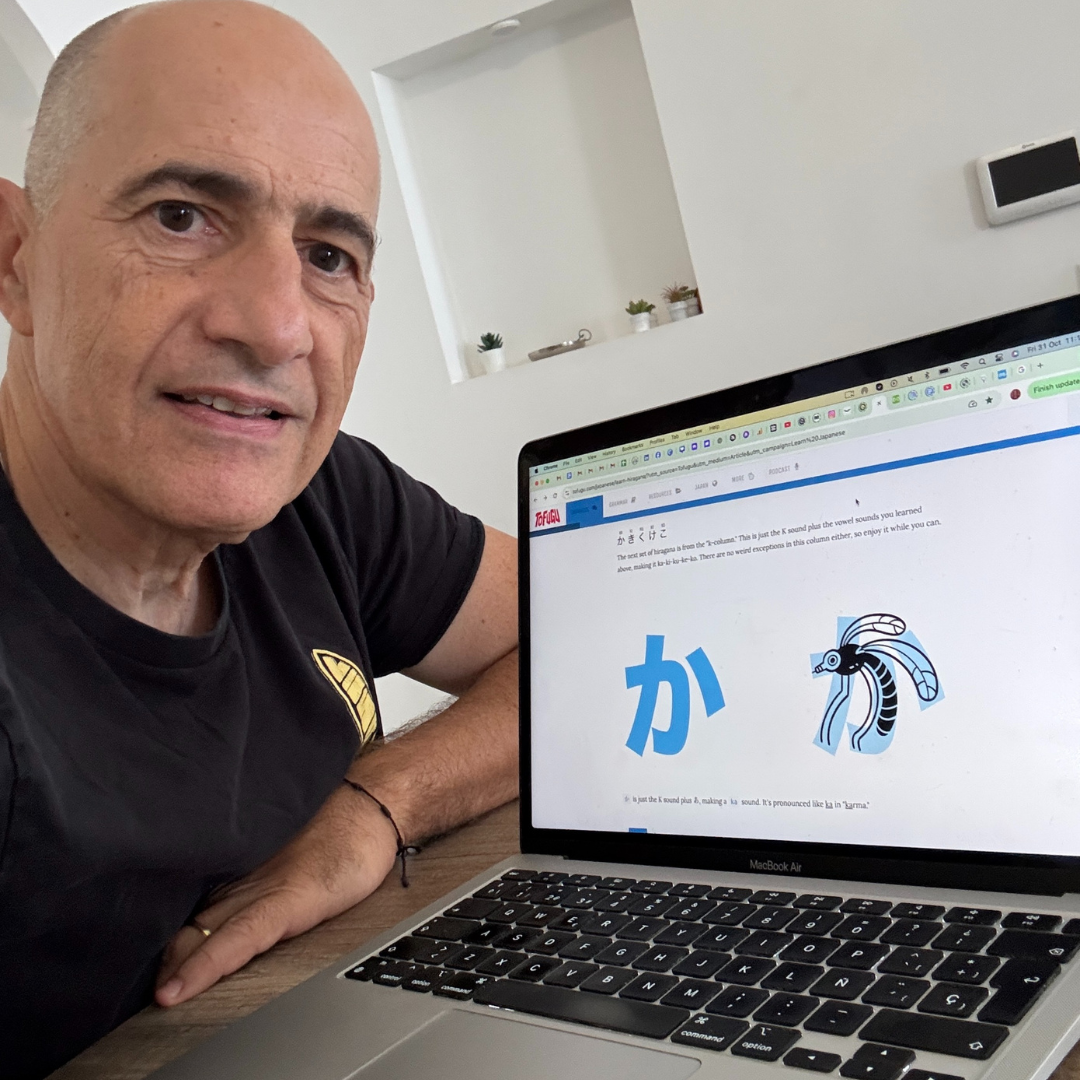
Portuguese benefited enormously from my knowledge of Spanish.
Japanese offers no such shortcut.
Its writing systems, vocabulary and grammar are fundamentally unfamiliar to me. Reaching a N5 level will require learning approximately 800 words, 100 kanji and around 80 grammar patterns.
The estimated investment is close to 300 hours.
Why make that investment?
Because I am preparing to walk across Japan in 2027.
I could complete the journey without speaking Japanese. But crossing a country is not the same as entering the lives of the people who live there.
Language could turn a transaction into a conversation, a passing encounter into a relationship and something observed from the outside into something better understood.
Every word I learn before leaving may open a possibility that would otherwise remain inaccessible.
My plan is to study for approximately 30 to 60 minutes a day over 18 months, supported by two to three weeks of intensive classes in Japan.
Portuguese tested what intensity could produce in one month.
Japanese will test what consistency can produce over a much longer period.
Can we still learn after 60?
The Japanese experiment tests a notion many of us absorb as we age: that our ability to learn something difficult is largely behind us.
Learning Japanese at 66 is partly a test of memory. But it is also a test of something larger: the belief that we are not finished growing and that some of our best years may still lie ahead.
As adults, we often interpret the discomfort of being a beginner as evidence that we are no longer capable of learning.
Children expect not to understand.
Adults expect competence. When it does not arrive quickly, we may blame our age rather than our method, environment or expectations.
Age undoubtedly affects how we learn. Memory and processing speed may change.
But age can also bring experience, self-knowledge, discipline and a better ability to create the conditions we need.
The experiment is not intended to prove that learning at 66 is the same as learning at 20.
It asks a more useful question:
How much can we still learn after 60 when we stop comparing ourselves with our younger selves and start working intelligently with the abilities we have now?
The challenge is not to pretend that I still have the brain I had at 20.
It is to discover what I can do with the brain I have at 66.
What comes next
The Portuguese challenge lasted four weeks.
The language experiment continues.
Japanese now puts the lessons from Portugal under greater pressure: a more distant language, a longer commitment and far fewer familiar reference points.
This time, the challenge is not to generate maximum intensity for one month. It is to protect consistency for 18 months.
That may prove more difficult.
I do not yet know whether I will reach N5 before the walk. The outcome is uncertain and that is precisely why this remains an experiment.
The purpose is not to prove that anyone can learn any language at any age.
It is to distinguish the constraints that are real from the ones we accept without testing and to see what becomes possible when we deliberately improve the odds.
Potential tells us what might be possible. An experiment reveals what we can actually make possible.
Walk your talk,
Franck
P.S.:
- What ambitious target have you missed—and what did pursuing it make possible? Reply and tell me. I read every response.
- If someone else needs this perspective, forward it to them. They can join WTFT here.
- WTFT is free for everyone. If you would like to support the experiments behind it, you can leave a tip
New possibilities delivered to your mail
Free. Only when I have something worthy to share. Unsubscribe anytime.

Member discussion