Why I’m going to Fukuoka before I walk across Japan
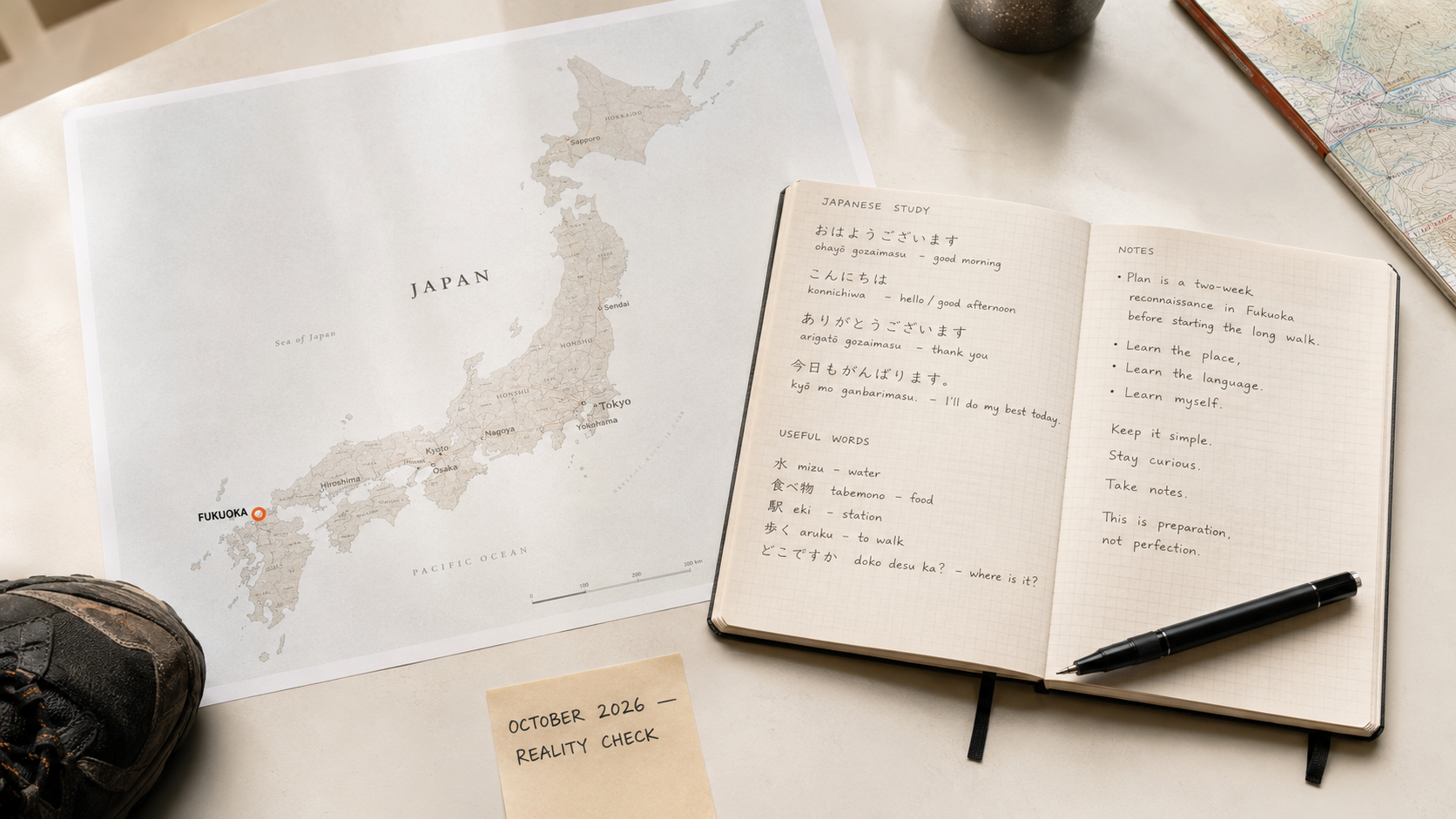
In October, I am spending two weeks in Fukuoka.
The trip began with a simple opportunity. John, a good friend from Chiang Mai, will be attending a convention for digital nomads there. It seemed like a good chance to see him again and make progress on my 3,000 km walk across Japan in 2027.
The reason I chose this walk for my next challenge is explained in the Japan experiment.
I am already planning the route, researching logistics and learning Japanese from Portugal. Much of that work will continue from here.
Fukuoka gives me an opportunity to move part of my preparation from theory into practice.
This trip has three practical objectives.
Make my Japanese usable
My online Japanese lessons give me a structured environment. The context is clear, my teacher understands my level and I have time to think.
In Fukuoka, I will attend classes every morning and use what I learn in real interactions.
I want to discover where communication breaks down, how I respond when it does and what I most need to improve before the walk.
Challenge my plan with local knowledge
Maps and online research can take the planning a long way.
But people who know Japan may identify impractical stages, overlooked lodging problems or assumptions that are difficult to detect from a distance.
I hope to identify the weakest points in my plan: from weather and terrain to payment methods, useful mobile apps, hiking rules and other practical details.
Find people who might help
The walk will require more than a route.
I want to meet local contacts, possible videographers, potential partners and people who might accompany part of the journey or introduce me to others along the way.
Meeting people in Japan will help me understand whether the project interests anyone and whether I am explaining it clearly.
What would make the trip worthwhile?
The trip will have done its job if I return with:
- A clearer Japanese study plan
- Specific route and logistical problems to solve
- A few promising local relationships
- A more concrete sense of the fun—and discomfort—I am signing up for between Cape Sata and Cape Soya.
Walk your talk,
Franck
P.S.:
- Do you know Fukuoka? What should I experience or pay attention to beyond the obvious attractions? Reply and tell me. I read every response.
- If you know anyone connected to Japan, please forward this post to them. They can follow the preparation and the walk here.
- WTFT is free for everyone. If something I share gives you a useful perspective, a coffee helps me keep WTFT moving.
New possibilities delivered to your mail
Free. Only when I have something worthy to share. Unsubscribe anytime.

Member discussion