Le Tour de Gaule
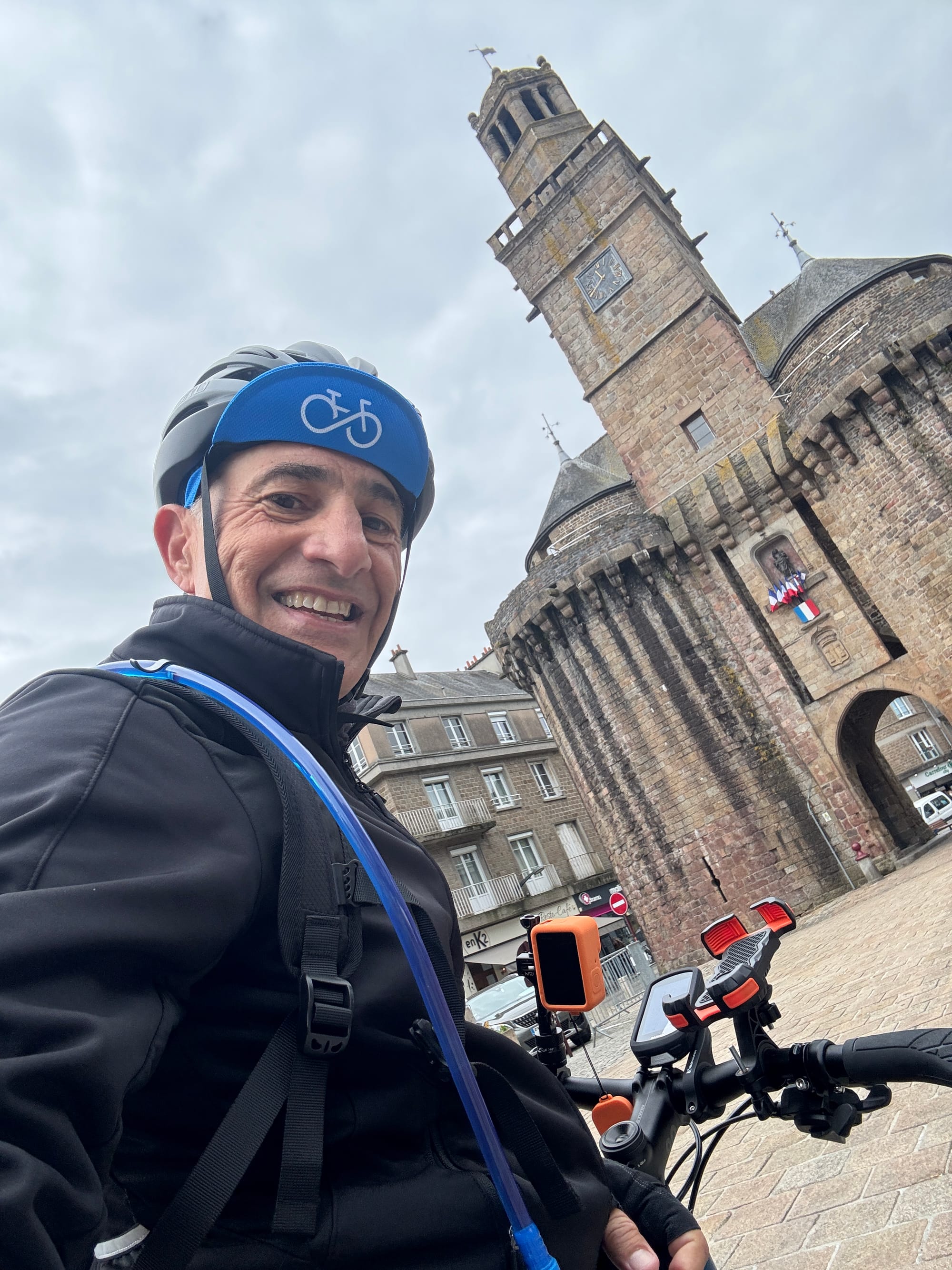
The idea came to me while I was walking across France.
Although I am French, I kept discovering regional foods and traditions I barely knew. It reminded me of “Le Tour de Gaule d’Astérix”, a comic in which Asterix and Obelix travel around Gaul collecting local specialities.
What if I recreated that journey?
Not in a horse-drawn cart.
On a bicycle.
I would cycle around France, tasting regional specialities along the way and meeting the people who keep them alive.
It had the ingredients of an engaging adventure. But it also offered something more valuable: another opportunity to put the ideas behind WTFT under pressure in the real world.
So I designed the Tour de Gaule.
The experiment
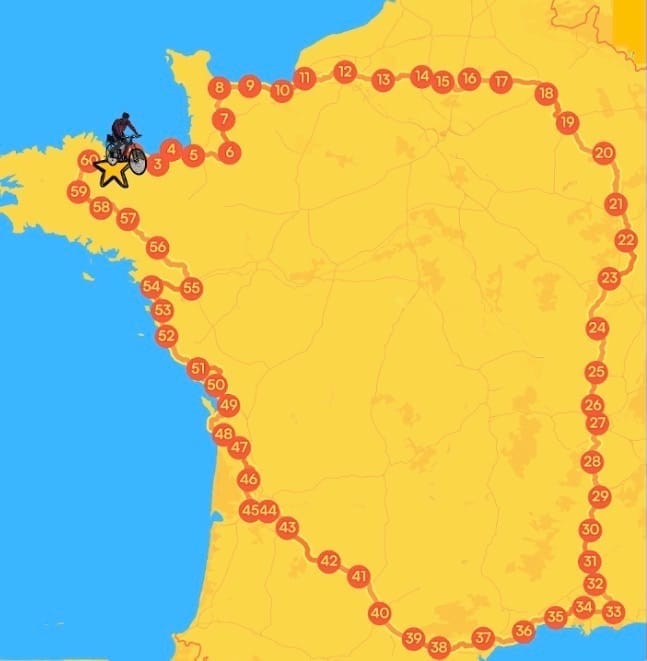
The challenge was a self-supported loop of approximately 3,200 kilometres around France: 60 riding stages over 70 days, starting and finishing in Saint-Brieuc, Brittany.
I would carry everything I needed and experience the country through its landscapes, food and people.
There was no support vehicle, no electric assistance and no certainty that my body, bicycle or plan would hold together.
I also wanted to examine several assumptions:
- Does commitment reduce freedom or create it?
- Does experience make difficult things easier?
- Is an adventure a cost, an investment or both?
- Does getting older inevitably reduce what we can do?
- How much should we plan, and how much should we trust ourselves to adapt?
- Is something either work or a holiday or can it be both?
- Does being alone necessarily mean being lonely?
These were not abstract questions.
My own time, money, body and choices were on the line.
The road had other plans
Three kilometres into the first stage, the gearbox on my brand-new bicycle failed.
I was left riding a fully loaded bike on a single fixed gear. On Brittany’s rolling hills, that quickly became impossible.
After 15 kilometres, I rested, exhausted, on the side of the road. The experiment had barely begun, and the plan was already obsolete.
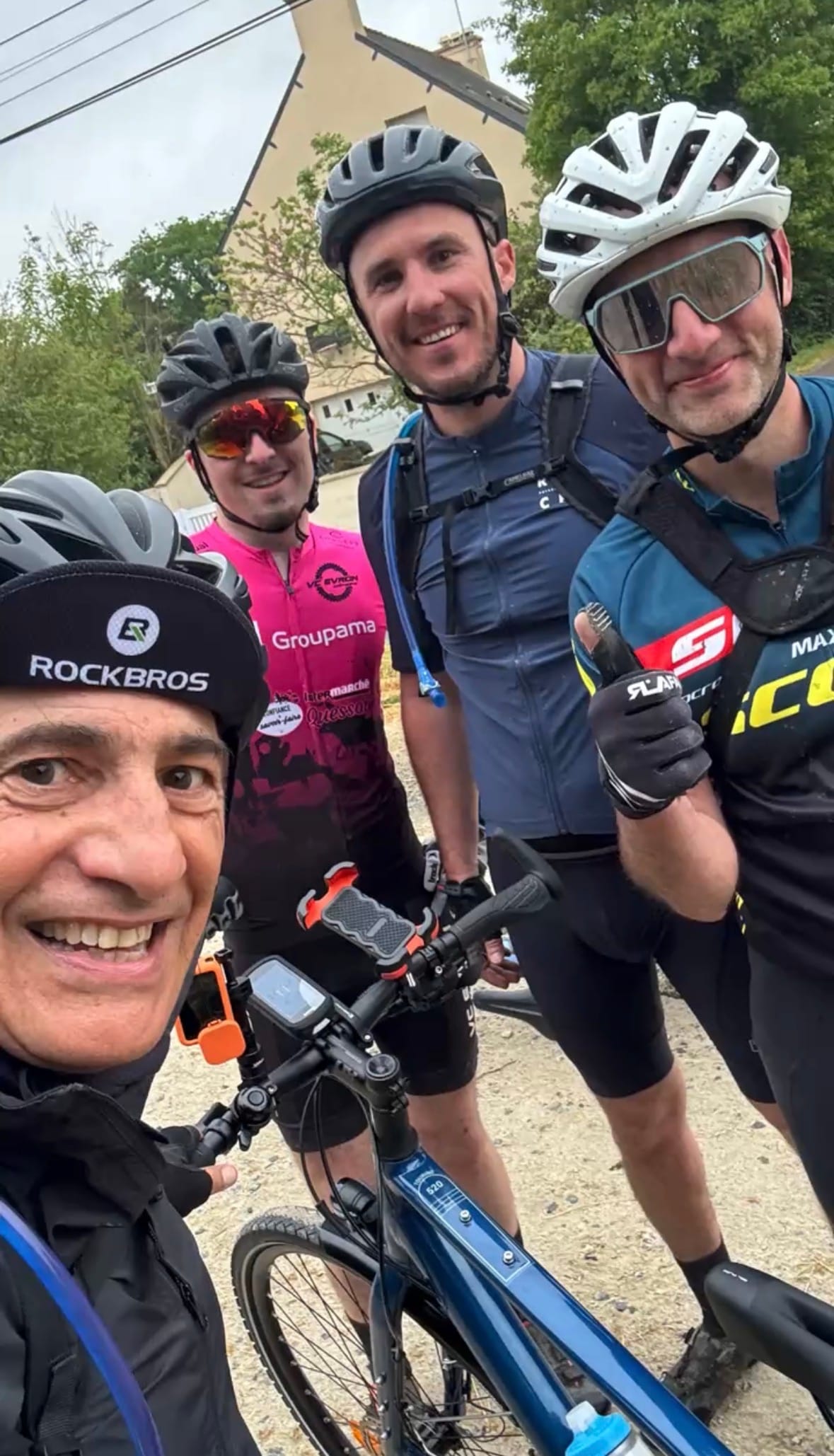
Then three cyclists appeared.
They could easily have passed by me with just a wave. Instead, they stopped and examined the problem. They eventually fixed it and got me moving again.
Without them, the first stage might have been a major setback. The breakdown revealed something the plan could never have anticipated: the impact and generosity of strangers.
The following days brought rain, headwinds, detours, and my first fall complete with a new “road tattoo.”
The ride continued through Brittany, Normandy and onward around France. I travelled through changing landscapes, weather and regional cultures, eating the specialities that had inspired the journey.
Belons in Cancale. Andouille in Vire. Nougat in Montélimar. Cassoulet in Castelnaudary. Teurgoule, falues, fougasse d’Aigues-Mortes, tielle de Sète and many others I had never previously encountered.
There were memorable drinks too: Kir Breton, Kir Normand, Burgundy and Rhône wines, and Provence’s alleged answer to the mistral: the pastis.
But the most useful discoveries were not always the most photogenic.
They came from ordinary stages when nothing remarkable happened, difficult days that looked easy on paper and conversations that exposed assumptions I hadn’t realised I was carrying.
What the experiment revealed
Before leaving, I could postpone the ride, alter it or abandon the idea entirely.
I still had every option.
That felt like freedom, but it kept the decision alive.
Once I committed, the 3,200 kilometres did not become easier. What changed was the question.
I no longer woke up asking whether I should ride.
Only how I would reach the next destination.
The effort remained. Much of the internal debate disappeared.
Practice does not always make the effort disappear
After weeks on the bicycle, I expected each stage to become easier.
I was fitter. More experienced. More familiar with the equipment and the rhythm of the road.
Yet cycling still required effort.
What had changed was not necessarily the difficulty of the work. It was my uncertainty about whether I could handle it.
Practice had not eliminated the effort.
It had increased my capability.
The circle closed
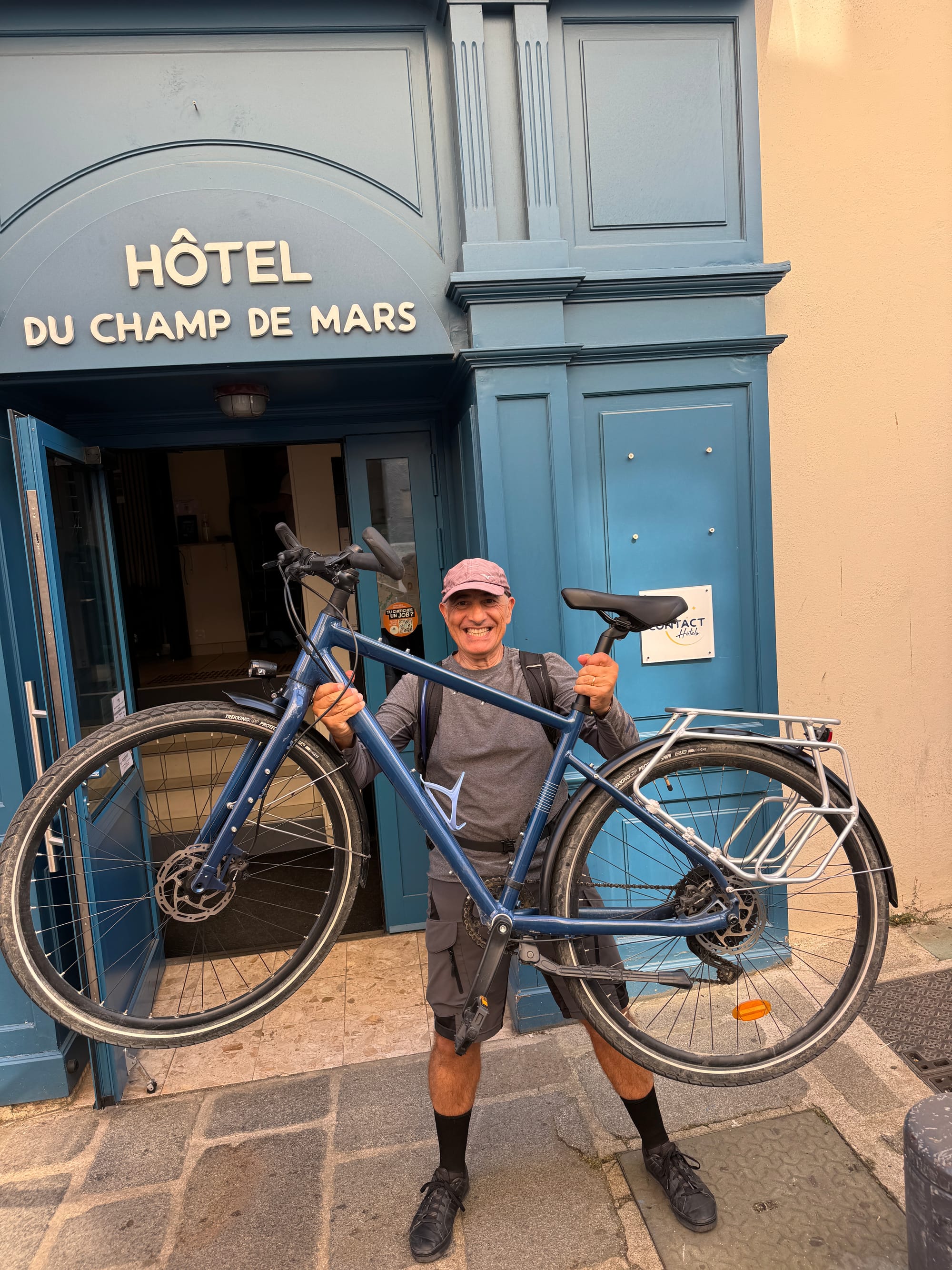
As I approached the end of the Tour de Gaule, I knew I would not take the bicycle back to Portugal.
The journey had begun with three strangers stopping when I needed help. They expected nothing in return, yet gave me their time, knowledge and encouragement.
I wanted to close the circle by gifting them the bicycle.
There was only one problem: I didn’t know their names. All I had was a selfie.
I posted a video on social media, hoping someone might recognise them.
Against the odds, the brother of one of the cyclists saw it. He put us in contact, and after my final stage, I handed him the bicycle.
I don’t know whether karma exists.
But I do know that generosity travels.
What began with three strangers' generosity ended, 3,200 kilometres later, with the bicycle returning to them.
The experiment continues
Le Tour de Gaule began as an attempt to rediscover France through its regional food.
It became an experiment in commitment, capability, expectations, adaptability, solitude and the generosity of people I had never met before.
I completed the 3,200-kilometre loop. But distance was only the visible result.
The more valuable outcome was everything the road forced me to reconsider.
Some assumptions were confirmed. Others collapsed on contact with reality. And some of the most important lessons came from events I would never have chosen or planned.
That is why I continue to experiment.
Not to prove that my choices are right for everyone, but to discover what they might help all of us see differently.
What might you discover if you were willing to put one of your assumptions to the test?
Walk your talk,
Franck
P.S.:
- How do you manage to outsmart your biases? Reply and tell me. I read every response.
- If someone else needs this perspective, forward it to them. They can join WTFT here.
- WTFT is free for everyone. If you would like to support the experiments behind it, you can leave a tip
New possibilities delivered to your mail
Free. Only when I have something worthy to share. Unsubscribe anytime.

Member discussion